

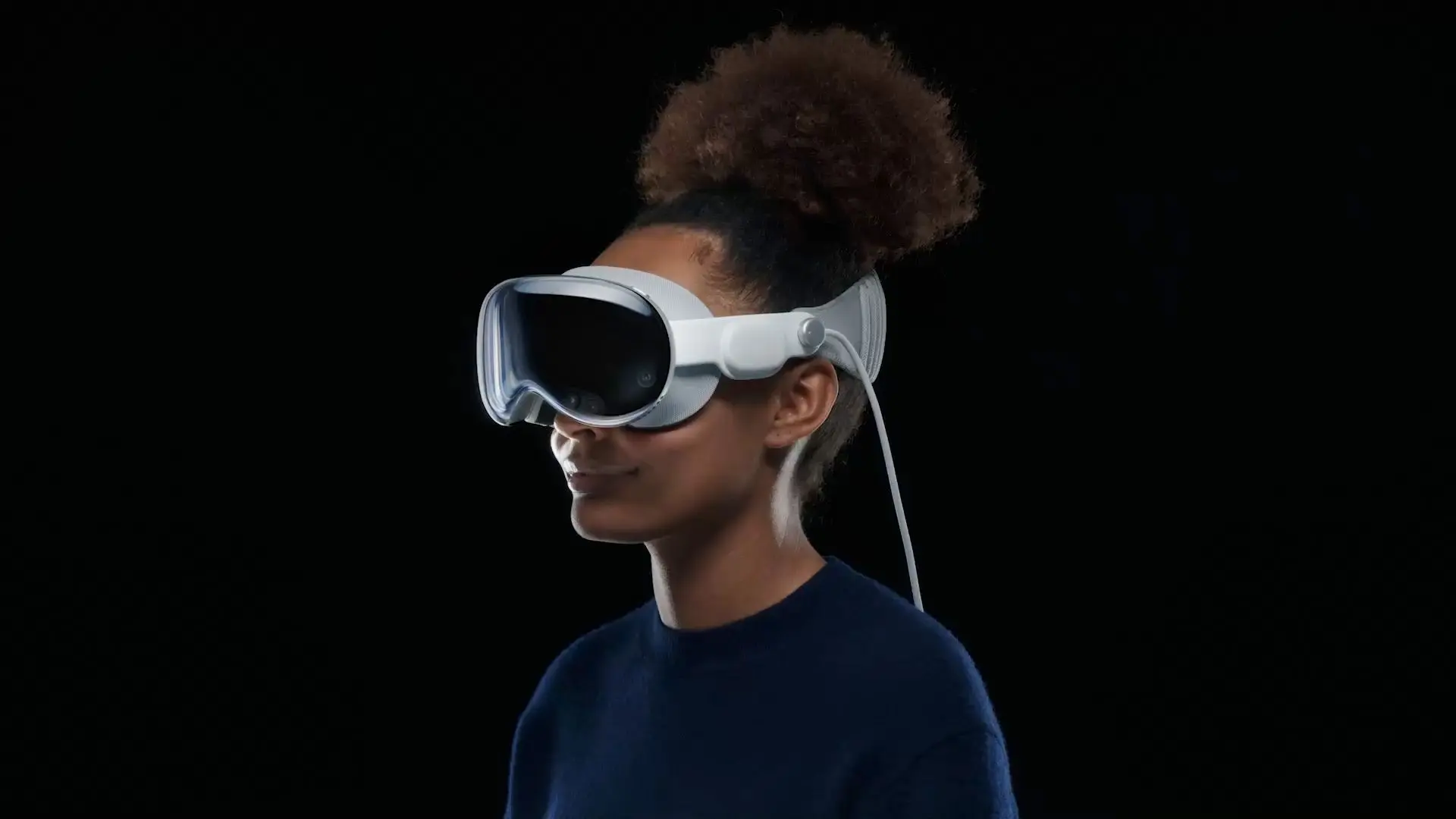
Should You Buy the Vision Pro?
The $3,500 Vision Pro remains prohibitively expensive for many consumers. Reviews have made it clear that this device does not easily fit into existing workflows for most people, and some users have regretted their purchase. However, the Vision Pro excels at watching movies, viewing 3D videos, and serving as a display for a Mac. The device weighs over 1.3 pounds, which can lead to fatigue quickly, but Apple improved comfort with the Dual Knit Band that launched alongside the M5 chip. Users considering a purchase should try it at an Apple Store and conduct thorough research on its capabilities before buying. The M5 refresh, released in October 2025, makes now a good time to buy, as another update is not expected for at least two years.
Apple Vision Pro Overview
Apple's Vision Pro is an augmented and virtual reality headset, though Apple calls it a spatial computer because of its ability to blend digital content with the physical world. It launched in February 2024 and received an M5 chip upgrade in October 2025. The headset is not see-through; everything you see is digital. Cameras map the real world and translate it into a digital image, while virtual reality mode shuts off the cameras completely. The Digital Crown controls the level of immersion.
Design
The Vision Pro resembles ski goggles, with a singular piece of laminated glass front attached to an aluminum alloy frame. A soft Light Seal attaches magnetically to the frame to block out light. Audio Straps with spatial audio speakers are at the sides, connected to a 3D knitted headband. The M5 model features a Dual Knit Band with two straps for better weight distribution and comfort. The band is breathable, cushiony, and stretchy, with a Fit Dial for adjustment. The headset is only available in silver.
Display
Inside are two micro-OLED displays with over 4K resolution per eye, totaling 23 million pixels. The M5 model can render 10 percent more pixels for sharper visuals and supports up to 120Hz refresh rates for reduced motion blur. An external EyeSight display shows the wearer's eyes to others, indicating whether the user is in an immersive mode or can see surroundings. Zeiss Optical Inserts are available for glasses wearers at $99 for readers or $149 for custom prescriptions.
Cameras and Sensors
The headset has 12 cameras and five sensors for mapping the environment, tracking hand gestures, and eye movements. Two cameras transmit over a billion pixels per second for augmented reality views. Infrared flood illuminators enhance hand tracking in low light. LiDAR sensors determine object size and location. Four infrared cameras and LEDs inside the headset enable eye tracking for navigation. Optic ID uses iris scanning for secure authentication, similar to Face ID. A 3D camera captures spatial photos and videos, with a clear indicator when recording.
Audio
Speakers in the audio straps provide spatial audio, with dual-driver pods near each ear. Six microphones handle calls and voice commands. The Vision Pro pairs with AirPods for lossless audio with ultra-low latency when using USB-C AirPods Pro 2 or AirPods Pro 3.
Processors and RAM
The M5 chip, built on third-generation 3-nanometer technology, has a 10-core CPU and 10-core GPU. Unified memory bandwidth is 153GB/s. The R1 chip processes input from cameras, sensors, and microphones within 12 milliseconds. The Vision Pro has 16GB RAM and storage options of 256GB, 512GB, or 1TB. The M5 chip enables faster AI tasks, improved graphics with ray tracing, and supports 120Hz refresh rates.
Battery Life
The external battery pack, worn at the hip or plugged into a power adapter, provides up to 3 hours of video playback or 2.5 hours of general use. M5 model battery life is improved by half an hour over the M2 version. Additional battery packs can be swapped for extended use.
visionOS
visionOS is the operating system featuring a three-dimensional interface navigated by eye movements, hand gestures, and voice. Apps can be placed anywhere in virtual space, resized, and stacked. The level of immersion adjusts via the Digital Crown. visionOS 26, released in September 2025, adds persistent widgets, more lifelike Personas, spatial scenes for 2D photos, and the ability to share experiences with other Vision Pro users in the same room. Mac integration allows the headset to serve as a single 4K display, with wide and ultrawide modes added in visionOS 2.2. visionOS 27 is expected to include new accessibility features like face gestures, vehicle motion cues, and generated subtitles.
How to Buy
The M5 Vision Pro is available from Apple online and retail stores in the US, UK, Canada, Australia, China, France, Germany, Hong Kong, Japan, Korea, Taiwan, and UAE. Pricing starts at $3,500 for 256GB. A Face ID scan is required to determine correct Light Seal and band fit. Zeiss lenses cost extra. No trade-ins are offered for the M2 model. The box includes the Dual Knit Band, Light Seal, two cushion sizes, a cover, polishing cloth, battery, USB-C cable, and power adapter.
Key Facts
The Vision Pro is Apple's most technically advanced product but has limited apps and games. It supports Apple Arcade and Bluetooth game controllers. FaceTime uses a Digital Persona for video calls. The headset can run iPhone and iPad apps. Reviewers note improved comfort with the Dual Knit Band and better performance with the M5 chip, though weight remains noticeable. Medical warnings include potential aggravation of heart conditions, migraines, eye issues, and seizures. Pregnant individuals should exercise caution. The Vision Pro may interfere with pacemakers and hearing aids.
Source: MacRumors News