

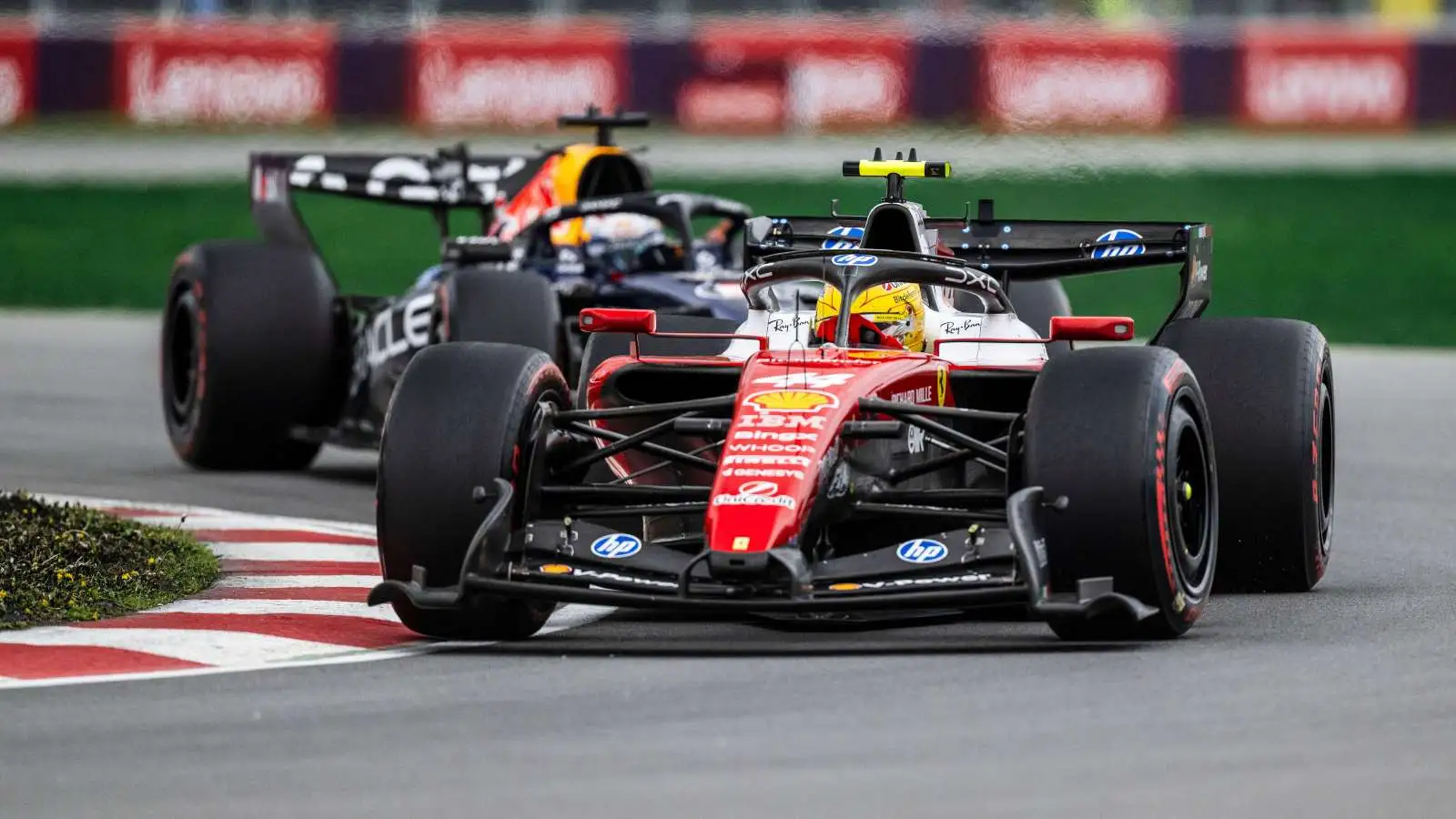
Lewis Hamilton delivered arguably his finest performance since arriving at Ferrari during the Canadian Grand Prix, engaging in a thrilling battle with old rival Max Verstappen that ultimately saw the seven-time world champion secure a deserved second-place finish. The track in Montreal has always been kind to Hamilton, who has now won seven times there, but this race presented a unique challenge as he had to fight against Red Bull's superior straight-line speed and Verstappen's aggressive defending. Using detailed telemetry data, we can uncover the strategic decisions that turned the tide in Hamilton's favor.
Race Weekend Overview
From the outset, Hamilton looked rejuvenated aboard the SF-25. Qualifying saw him narrowly miss out on a front-row start, settling for third behind the McLaren drivers. However, a strategic miscalculation by McLaren—choosing intermediate tyres at the start of a dry race—handed Hamilton an early advantage. He passed Oscar Piastri into Turn 1 and inherited third when Lando Norris pitted for slicks. Suddenly, the Ferrari driver was directly behind Verstappen, who had started second but was struggling with tyre warm-up on the soft compound.
Verstappen, however, found unexpected early pace on the softs, quickly closing the gap to Hamilton. By Lap 9, he executed a textbook overtake down the inside of Turn 1, leaving Hamilton frustrated. Radio transmissions captured Hamilton asking his engineers for more power, and telemetry reveals the reason: Hamilton had been overusing his electrical energy deployment in the middle sector to defend against Verstappen's attack, leaving his battery depleted on the start-finish straight. The Dutchman capitalized perfectly.
Telemetry Analysis: The Key Battle
Data from the first stint shows that once Verstappen entered Hamilton's danger zone (within one second), Hamilton began increasing his electrical deployment through the hairpin-to-T13 section. This left him vulnerable on the main straight, where Verstappen used a significant speed delta to sweep past. After losing position, Hamilton remained within a second of Verstappen for several laps, but a critical error on Lap 22—a front-right lock-up at Turn 8 that forced him wide—cost him four seconds and dropped him out of immediate contention.
The race was reset by a Virtual Safety Car triggered by George Russell's retirement. All front-runners pitted for medium tyres, setting the stage for a second duel. Verstappen, who had been strong on softs, struggled to bring the mediums up to temperature on the cold Canadian track. Hamilton, in contrast, found grip immediately. The telemetry graph from this period shows Hamilton was consistently faster, particularly in the traction zones of the Turn 8/9 chicane and the hairpin—areas where rear-axle grip is at a premium.
Hamilton's experience from the first stint taught him exactly how to attack. One lap before his move, he deliberately increased energy harvesting on the start-finish straight, sacrificing immediate speed to recharge his hybrid battery. He also altered his line through the final chicane, braking earlier and slower than on previous laps. Then, on the next lap, he unleashed all available electrical power on the main straight, carrying much higher speed down the outside of Verstappen. The speed difference was massive—telemetry shows the attack lap (yellow trace) was over 10 km/h faster than any previous lap at the same point. Despite the extra speed, Hamilton managed to brake cleanly and secure second place.
Historical Context and Significance
This race was a significant milestone for Ferrari, as it proved their car can be competitive on a power-sensitive circuit like Montreal. While the victory went to a charging driver from the midfield, Hamilton's performance demonstrated that Ferrari's aerodynamic and chassis development has closed the gap to Red Bull and McLaren. Team principal Frédéric Vasseur praised Hamilton's racecraft, noting that the British driver's ability to manage energy and tyres simultaneously has been a hallmark of his career.
For Verstappen, the defeat was a rare setback on a track where he has often excelled. The Red Bull driver struggled with tyre degradation on the medium compound, a weakness that has resurfaced intermittently throughout the season. While his early pace was encouraging, the inability to maintain rear grip cost him the podium position. Verstappen acknowledged after the race that Hamilton's overtake was "well executed" and that his own car lacked the balance to counter.
The Hamilton-Verstappen rivalry, which defined the 2021 season, has been reignited in 2026, albeit in a new context. Both drivers are now in different teams—Hamilton seeking his eighth title with Ferrari, Verstappen chasing his fifth with Red Bull. Their battle in Canada was a classic example of two champions pushing each other to the limit, with telemetry revealing the micro-decisions that separate victory from defeat.
The result also has implications for the constructors' championship. Ferrari's strong showing in Canada—coupled with McLaren's strategic errors and Russell's retirement—allowed them to close the gap to the leaders. If the team can maintain this level of performance on upcoming circuits that reward downforce and traction, they could become regular challengers for race wins. Hamilton's confidence is clearly growing, and his ability to adapt his driving style to the Ferrari's characteristics is improving with each weekend.
As the season progresses, the Canadian Grand Prix will be remembered as the race where Hamilton's Ferrari masterclass turned the tables on Verstappen. Without the luck of a VSC and mistakes from others, his path to second place might have been harder, but the telemetry shows that when the car was in the window, Hamilton extracted every ounce of performance. For fans of racing, this was a reminder that even in an era of technical complexity, driver skill and strategy remain decisive.
Source: PlanetF1 News