

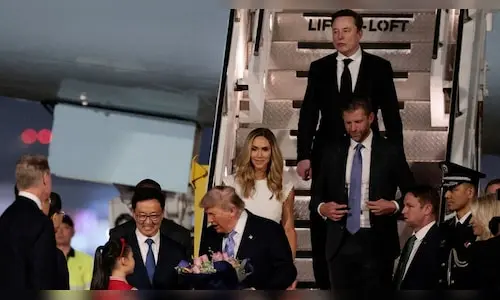
Elon Musk, the world’s richest person and CEO of Tesla and SpaceX, flew to China alongside US President Donald Trump for a three-day state visit from May 13 to 15. The trip came despite a federal judge placing Musk on recall status in his ongoing $150 billion lawsuit against OpenAI and its co-founders Sam Altman and Greg Brockman.
On April 30, Judge Yvonne Gonzalez Rogers of the Northern District of California was direct with Musk after his testimony in the courtroom: “Mr Musk, you are not excused, but you can leave for the day.” According to NBC News, Musk interpreted the first part of that sentence literally but ignored the second. He subsequently booked a flight to China without seeking the court’s permission. Recall status means a witness can be called back to the stand at any moment, although it does not come with strict physical monitoring like a GPS ankle bracelet.
The trial stems from Musk’s allegations that OpenAI, which he co-founded in 2015 with Altman and Brockman, abandoned its original nonprofit mission of developing artificial intelligence for the benefit of humanity. Instead, Musk claims, the company became a “for-profit, closed-source entity” controlled by Microsoft. Musk is seeking around $150 billion in damages and demands that Altman and Brockman be removed from their leadership roles.
Background of the OpenAI Lawsuit
Musk parted ways with OpenAI in 2018 after a power struggle over its direction. He had invested millions in the initial nonprofit but later accused the organization of putting profit ahead of ethics. The lawsuit, filed in 2024, alleges breach of contract, breach of fiduciary duty, and fraudulent misrepresentation. OpenAI and Microsoft have moved to dismiss the case, arguing that the terms Musk relies on were never binding.
The April 30 court session was part of a multi-week trial that saw Musk testify for nearly two days. During his testimony, he described himself as a “defender of ordinary people” against the perils of unchecked artificial intelligence. He contrasted his own approach with that of “Silicon Valley titans who care more about money than humanity.”
The Court’s Recall Status and the Trip to China
Judge Rogers placed Musk on recall status after the end of his testimony, meaning he could be called back if the defense needed to cross-examine him further or if new evidence arose. Legal experts noted that recall status is unusual for high-profile figures and typically handled through attorney coordination. “If I were the attorney, I would have made sure that if my witness is subject to recall and he’s left the country, that the judge is OK with that,” said Jeffrey Bellin, a law professor at Vanderbilt University.
Sources told NBC News that Musk left the United States without the court’s explicit permission. However, as of Wednesday, the final day of evidence, Musk had not been recalled. Closing arguments were set for Thursday, and a verdict could come as early as next week. The practical risk passed without incident, but the decision to travel during an active trial raised eyebrows among legal commentators.
Musk’s Relationship with Trump and the China Visit
Musk’s presence on Trump’s flight to China underscores his evolving political ties. Though Musk has described himself as “politically moderate,” he has been increasingly aligned with Trump on issues such as immigration, free speech, and technological sovereignty. Trump’s three-day visit to China aimed to negotiate tariff reductions and deepen economic cooperation. Musk, a major industrialist with factories in China, joined the delegation to discuss expanding Tesla’s presence in the electric vehicle market.
China is Tesla’s second-largest market after the United States, and the company’s Shanghai Gigafactory has been pivotal to its global supply chain. Musk’s attendance at the state dinner and trade talks signals his ongoing commitment to the Chinese market despite geopolitical tensions. During the trip, Musk also met with Chinese Premier Li Qiang to discuss potential collaborations in autonomous driving and battery recycling.
Implications for the Tech Industry
The lawsuit against OpenAI has broader implications for the entire AI sector. If Musk wins, it could force OpenAI to revert to an open-source nonprofit model or dissolve the Microsoft partnership. This would reshape the competitive landscape, affecting companies like Google DeepMind, Anthropic, and Meta. Critics argue that Musk’s legal battle is less about altruism and more about his desire to slow down rivals in the AI race. Meanwhile, OpenAI has continued to release advanced models like GPT-5, drawing scrutiny from regulators worldwide.
Musk’s own AI venture, xAI, launched Grok, a chatbot that competes with ChatGPT. The timing of the lawsuit coincides with xAI’s efforts to raise capital and secure computing resources. Some industry insiders view the legal action as a strategic move to damage OpenAI’s reputation while promoting xAI.
Legal and Ethical Considerations
The incident of leaving the country while on recall status highlights the challenges of enforcing court orders when the subject is one of the most powerful individuals in the world. Legal experts note that judges have discretion in such matters, and it is unlikely Musk will face sanctions unless he deliberately violated a specific order. However, the perception of disregarding judicial authority could influence the jury or public opinion.
Musk’s attorneys have declined to comment on the trip, but they have maintained that their client was acting within his rights. The judge has yet to rule on any motions related to Musk’s travel. In a related development, OpenAI’s legal team has filed a request for the court to remind Musk of his obligations, though no further hearings have been scheduled.
As the trial enters its final stage, observers are watching closely to see how the jury weighs Musk’s credibility. His decision to prioritize a political trip over court availability might be seen as a sign of arrogance or, alternatively, as a reasonable choice given the low likelihood of recall. The verdict will have lasting consequences not only for Musk and OpenAI but also for the future governance of advanced AI technologies.
The narrative of a tech titan taking on former collaborators in public court is compelling, but it also raises questions about accountability and the rule of law. With billions of dollars at stake and the direction of artificial intelligence development on the line, the outcome of this trial will resonate far beyond the courtroom.
Source: CNBCTV18 News