

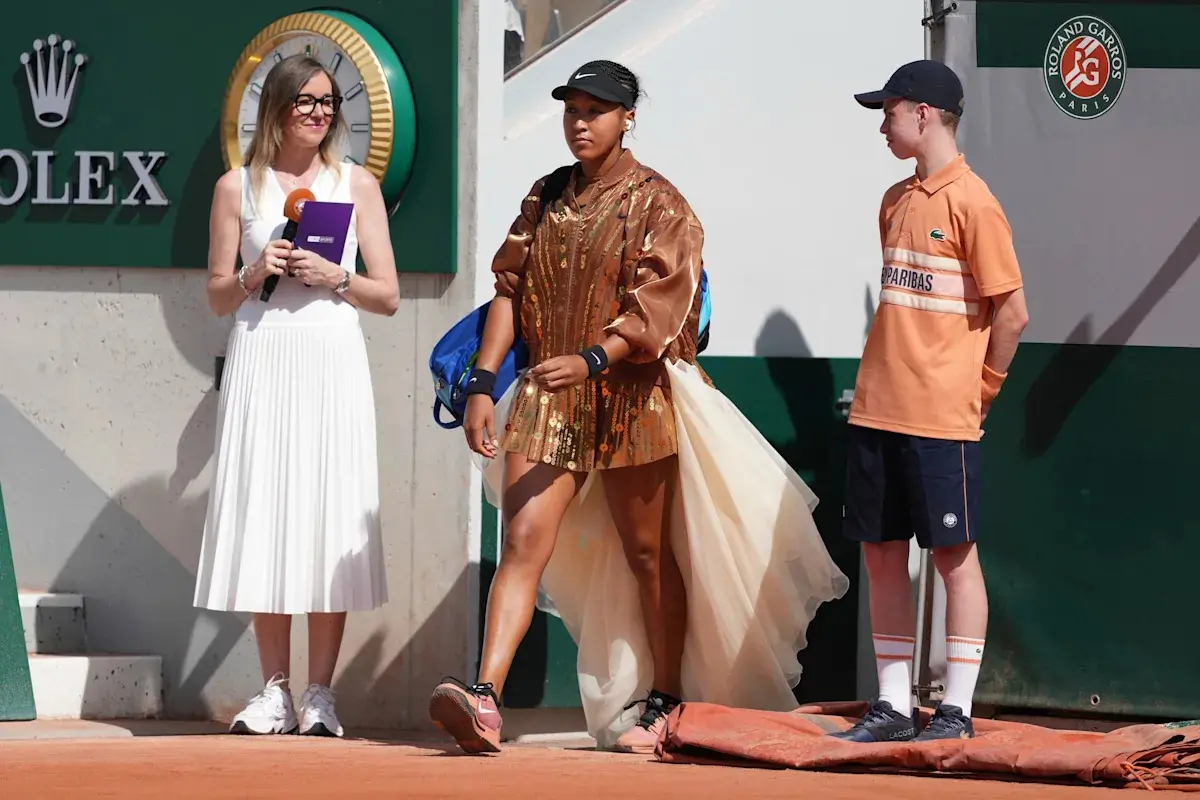
PARIS — Naomi Osaka keeps bringing the fashion in Paris. For her walk-on before a second-round win at the French Open, the tennis star wore a metallic gold bomber jacket over her sequined gold playing dress, offset by an ivory train in a look that mixes sportswear with couture.
“The inspo was, I don’t want to say Victorian, but you know the ladies that have the dresses with the poof in the background?” Osaka said. “(It's) so terrible of me to not know the correct term of that.”
The term Osaka was looking for is likely bustles, which were padded undergarments used to add fullness to dresses in the mid to late 19th century. After the walk-on, Osaka took off the train and jacket and handed the garments to a ball kid to remove them before the match against Donna Vekic on Court Simonne-Mathieu on Thursday.
“I like to keep people on their toes and I think it’s really fun,” Osaka said in her post-match interview on court, refusing to reveal if she has a new outfit for every possible match of the tournament. “There’s a community I feel like that’s been built over my on-court outfits. So I just like to just keep you guys guessing.”
Osaka won 7-6 (1), 6-4 to reach the third round at Roland Garros for the first time since 2019. “It means a lot,” she said. “I just feel so grateful. It’s another milestone.” For her opening match two days earlier, Osaka walked on in a ceremonial black skirt and sleeveless beaded bodice before revealing her gold dress, which she said reminded her of the Eiffel Tower sparkling at night.
“Athletes are in show business,” Osaka said after beating Laura Siegemund in her opener. “Grand Slam walk-ons are the only time that I possibly feel like I’m an entertainer.”
Osaka's opponent says walk-ons ‘problematic’
Siegemund said Osaka’s walk-ons were “yet another example of big names being treated differently” in tennis. Siegemund told Eurosport Germany she didn’t mind the outfits but found it “a bit problematic” that it took Osaka so long to get ready and lesser-known players were under pressure to unpack their gear as fast as possible to avoid time violations. “I came here to play tennis, not to put on a fashion show,” Siegemund added after losing to Osaka. “If other people want to do a fashion show, they can do that. It’s fine for me.”
Vekic had no issues. “It’s just something different,” Vekic said. “Some people take tennis way too seriously. Just relax. It’s just an outfit. It’s no big deal. She has an opportunity to do that so why not.”
The fashion statements at Grand Slam events have a long history. Tennis players have used their on-court attire to express personality and make bold statements for decades. From the all-white dress code at Wimbledon to the colorful designs seen at the French Open and US Open, players have pushed boundaries. Osaka, a four-time Grand Slam champion, has been at the forefront of this trend, often collaborating with designers like Nike and her own brand to create custom outfits that reflect her heritage and personal style. Her Japanese-Haitian background often influences her choices, blending traditional elements with modern sportswear.
Osaka’s journey in tennis has been marked by not only her powerful game but also her advocacy for social justice issues. She has been vocal about mental health, racial equality, and women’s rights, using her platform to bring attention to these causes. Her fashion choices at the French Open this year continue to draw attention, but they also highlight the broader conversation about individual expression in sports. While some traditionalists argue that the focus should remain purely on the athletic competition, others welcome the infusion of personality and showmanship into tennis.
The controversy over walk-ons is not new. In recent years, players like Serena Williams and Roger Federer have also made headlines with their pre-match fashion choices. Williams, known for her catsuits and tutus, often took center stage at Grand Slams. Federer’s classic but stylish outfits from Nike and later Uniqlo also garnered praise. However, Osaka’s approach is different because she treats each walk-on as a separate fashion moment, with thematic elements that often tie into the tournament location or her mood.
Osaka’s 2026 French Open campaign has been notable not just for her outfits but also for her performance. After struggling with injuries and form in recent years, she has shown signs of a resurgence. Her victory over Vekic was a hard-fought battle, showcasing her signature aggressive baseline game and calm demeanor under pressure. The third round will be a test of her mentality and fitness, as she aims to go deeper into the tournament than she has in six years.
The French Open is the only Grand Slam where Osaka has not won a title, with her best performance being the third round in 2019 and 2021. She has often cited the clay court surface as a challenge, but this year she seems more comfortable. Her fashion statement is part of building her confidence and connection with the Parisian crowd, who have embraced her flair.
The reaction to Siegemund's comments has been mixed. Some fans argue that Osaka's elaborate walk-ons are a form of entertainment that brings more viewers to the sport, while others agree with Siegemund that it creates unfair disparities. The French Federation has not commented on the matter, but the rules allow players to wear what they wish as long as it adheres to the dress code. Osaka's outfits have been within regulations, though her train required a ball kid to assist, which raised questions about potential delays. However, no official time violations were issued.
Osaka herself seems unfazed by the criticism. In her post-match press conference, she emphasized that her fashion choices are a way to connect with fans and express her creativity. “I’ve always loved fashion,” she said. “It’s a way for me to tell a story without speaking. I think it adds an element of drama to the sport, and I enjoy being part of that. I understand not everyone will like it, but I’m doing it for myself and for the people who appreciate it.”
The future of tennis fashion is likely to become even more diverse. With the rise of social media and player brands, athletes have more control over their image than ever before. Collaboration with high fashion houses is becoming common. Osaka, for example, has worked with Louis Vuitton and SVP. This trend means that walk-ons and outfits are now part of the overall Grand Slam experience, as important as the matches themselves for many viewers.
As Osaka prepares for her third-round match, all eyes will be on what she wears next. She has kept her plans close to the chest, but fans are speculating about more surprises. Whether it is a tribute to French culture, a nod to tennis history, or a completely new concept, Osaka is sure to deliver. Her ability to blend performance with fashion has made her one of the most marketable athletes in the world, and her influence on the sport extends beyond the court.
In the meantime, the debate about player walk-ons continues. Some argue for stricter time limits to ensure fairness, while others advocate for complete freedom of expression. The French Open officials have not indicated any changes to the rules, but the issue could be discussed at future ATP and WTA meetings. For now, Osaka remains focused on her game, using her fashion as a tool to enhance her mental state and entertain the crowd. Her journey in Paris this year is a testament to her resilience and creativity, both on and off the court.
With each passing round, Osaka is rewriting her story in Paris. From struggling on clay to finding her rhythm, she has shown that she is a force to be reckoned with. Her fashion statements are just one part of her overall narrative, but they are a vivid reminder that tennis is not just a sport—it is a stage for self-expression. As she continues to break barriers and set trends, Naomi Osaka is proving that style and substance can go hand in hand.
Source: Yahoo Sports News