

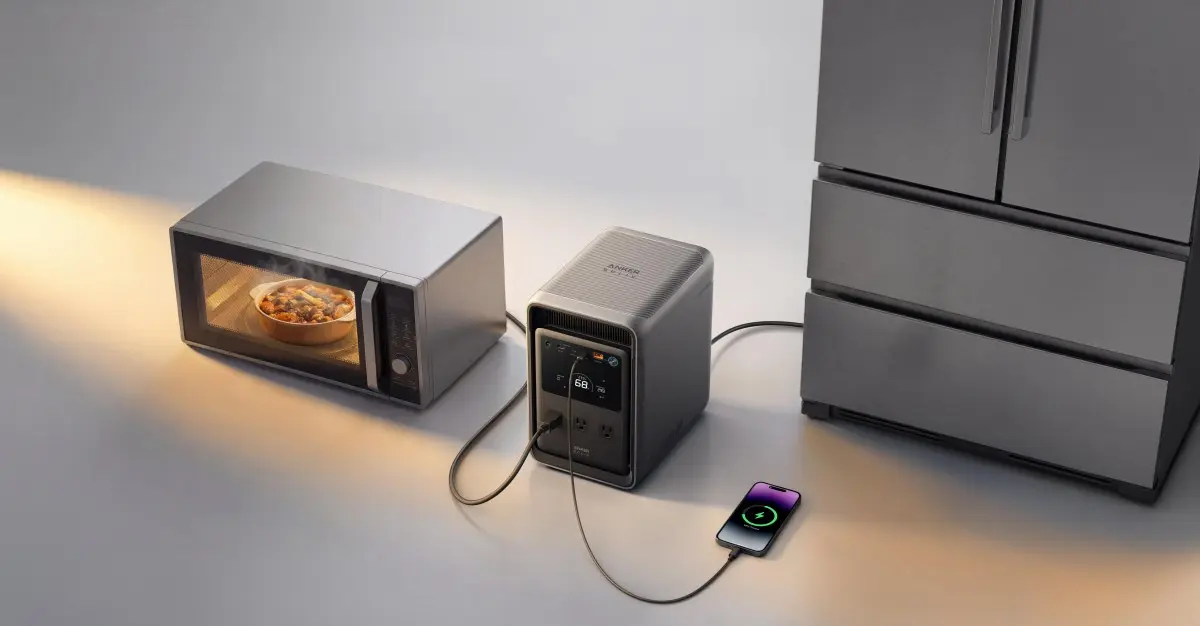
Anker's Solix S2000 power station addresses two of the most frustrating issues with portable power stations: idle power draw and physical size. Most large power stations in the 2kWh range silently consume 30W or more when left on, which can fully drain the battery in just a few days if the AC output is accidentally left running. The Solix S2000 cuts that standby consumption to about 6W, thanks to Anker's OptiSave technology and a carefully chosen 1500W inverter. This allows the battery to last nearly two weeks without any active load, compared to less than a week for many competitors.
The second improvement is size. At 208 x 282 x 323mm, the Solix S2000 packs 2kWh of LFP (lithium iron phosphate) battery capacity into a footprint that is significantly more compact than rivals like the EcoFlow Delta 2 Max, Bluetti AC200L, or Jackery 2000 Plus. Its energy density of about 106Wh/L is among the best in its class, making it an excellent choice for vanlifers and RV owners who need every inch of space. The 35.7-pound (16.2kg) weight is manageable for a unit of this capacity, and the inclusion of AC outlets on both the front and back further improves usability by reducing the need to move the heavy unit around.
OptiSave Technology and Inverter Strategy
Anker's OptiSave system is the key to the S2000's low idle power draw. While many power stations use high-wattage inverters (2400W or more) that inherently consume more energy when idle, Anker opted for a 1500W continuous inverter. This is still enough to run most household appliances, including refrigerators, coffee makers, water boilers, small induction cooktops, CPAP machines, and networking gear. The inverter can handle peaks of up to 3000W for short periods, which covers high-draw devices like hair dryers. The trade-off is that the S2000 cannot run certain heavy-duty appliances simultaneously, but for typical home backup or camper use, 1500W is sufficient.
The low idle draw is a game-changer for anyone using a power station as a standby backup for home essentials. Many users have experienced the frustration of a fully charged power station that dies overnight due to phantom drain when left connected to a fridge or other appliance. With the Solix S2000, you can leave the AC output on for extended periods without worrying about waking up to a dead battery. This also extends the battery's overall lifespan, as LFP batteries already offer 3000-6000 charge cycles compared to 500-1000 for lithium-ion.
Ports and Connectivity
The S2000 offers a variety of input and output ports. It includes two USB-C jacks that deliver up to 100W each, one USB-A port, and a 400W solar panel input for off-grid charging. The AC outlets are spread across the front (three) and back (two), allowing flexible placement. The unit also supports expansion through additional batteries, though Anker has not yet announced a dedicated expansion battery for the S2000. The solar input is MPPT-based and efficient enough to fully recharge the battery in about 5-6 hours under optimal sun conditions. AC charging is faster, taking around 1.5 hours using standard wall power.
Pricing and Availability
The Solix S2000 is launching with an aggressive introductory price: $599 for preorders before June 1. After that, the regular price will fall between $679.99 and $1,199.99, depending on retailer coupons and promotions. This works out to about $0.29 per watt-hour, which is significantly lower than many competing 2kWh LFP power stations that often retail for $0.50 to $0.80 per Wh. Early reviews of the US model have been positive, praising the low idle power, compact size, and build quality. EU pricing and shipping dates are expected to be announced in the weeks ahead.
Comparison with Competitors
When compared head-to-head with the EcoFlow Delta 2 Max (2kWh, 2400W inverter, idle draw ~30W), the Bluetti AC200L (2kWh, 2400W inverter, idle draw ~25W), and the Jackery 2000 Plus (2kWh, 2400W inverter, idle draw ~20W), the Solix S2000 stands out for its lower standby consumption and smaller footprint. However, those competitors offer higher continuous output and sometimes higher solar input rates. For users who prioritize efficiency and portability over raw inverter capacity, the S2000 is a strong contender. Anker also has the advantage of a well-known brand with a solid reputation for charging accessories and power banks, which may inspire confidence in buyers.
Another factor is the LFP battery chemistry, which is safer and longer-lasting than traditional NMC batteries. All major competitors now offer LFP in their mid-range to high-end models, but Anker's implementation appears to be particularly efficient thanks to OptiSave. The 6W idle draw is less than half of most competitors, which could translate to meaningful savings in energy over the lifetime of the product, especially for users who leave the power station on continuously.
Use Cases and Target Audience
The Solix S2000 is designed for a wide range of users. Vanlifers and RV owners will appreciate the compact dimensions and low self-discharge rate, which means they can leave the unit plugged in without worrying about battery drain when the vehicle is parked. Homeowners looking for a backup power source for critical loads like refrigerators, lights, and internet modems will find the 2kWh capacity sufficient for several hours during an outage. Contractors on job sites can power tools and chargers without the noise and fumes of a generator. The unit also has a quiet fan and operates silently when not under high load.
For those who need more capacity, Anker may eventually offer expansion options, but even as a standalone unit, the S2000 provides a compelling value proposition. The low idle power draw also makes it a good candidate for use in off-grid cabins or as part of a solar home system where every watt counts.
Anker's decision to prioritize efficiency and size over raw power could signal a shift in the power station market. Many consumers are realizing that they don't need 2400W+ continuous output for most applications, and that the trade-offs in standby consumption and physical bulk are not worth it. The Solix S2000 proves that a 1500W inverter can be sufficient for the vast majority of real-world scenarios, and that the benefits of lower idle draw and smaller size are tangible advantages.
Source: The Verge News